


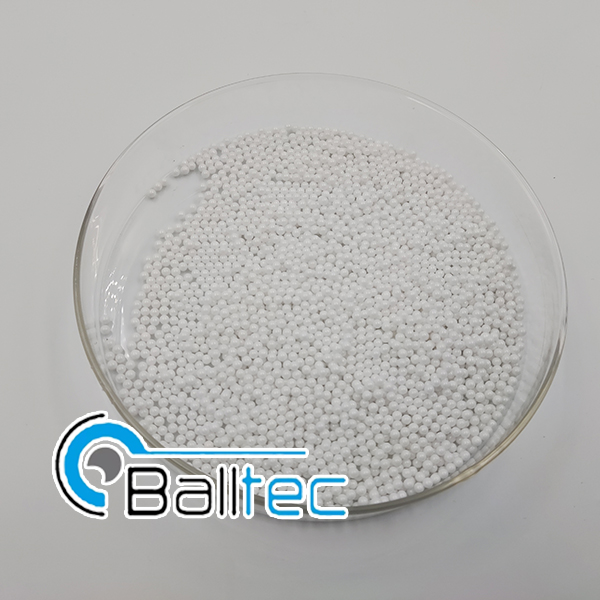
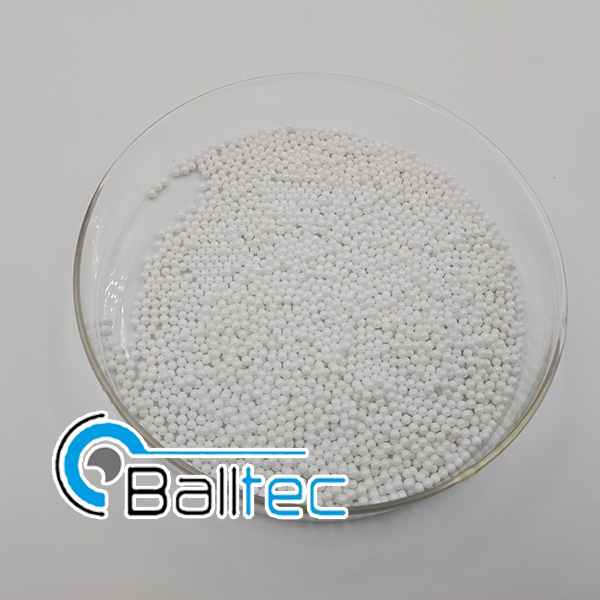
High-Purity Zirconia Grinding Media for Fine Chemicals Processing
The acid and alkali resistance of zirconia ceramics is relatively balanced. Zirconia itself is a very stable metal oxide, and its chemical bond (Zr-O bond) is very strong, which makes it have good inertness to most dilute acids and concentrated acids at room temperature. It is difficult for acids to react with it. Zirconia ceramics can be used under normal conditions in medium-strong acid or medium-strong alkali environments without any problem. However, it is not resistant to high-strength acids and alkalis. If the usage environment is a solution of salt acid with a concentration exceeding 1:9, or a solution of sodium hydroxide with a concentration greater than 10%, zirconia ceramics will still have obvious corrosion.
For most inorganic acids and organic acids at room temperature or medium-low temperatures, whether it is hydrochloric acid, nitric acid, sulfuric acid (medium-low concentration), phosphoric acid, or organic acids such as acetic acid, 95% zirconia beads show excellent corrosion resistance. This is an important reason for its wide application in the grinding and dispersion industries, especially in applications that are sensitive to metal ion contamination such as paints, inks, dyes, pesticides, electronic ceramics, etc.
Zirconia ceramics itself has properties of being wear-resistant, acid and alkali corrosion-resistant, high-temperature resistant, and good insulation. Because this raw material is relatively cheap and easily obtainable, it is widely used in multiple industries such as chemical engineering, electronics, refractory materials, machinery, etc.
Product Specifications
|
Parameter |
Specification |
Remarks |
|
Material Composition |
ZrO₂ ≥95%, Y₂O₃ 3–8 mol% |
Yttria-stabilized for structural stability |
|
Impurity Content |
Fe₂O₃ ≤0.02%, SiO₂ ≤0.03%, Al₂O₃ ≤0.03% |
Meets fine chemical purity standards |
|
Vickers Hardness (HV) |
1250–1450 |
Measured at 25°C, ensuring wear resistance |
|
Density (g/cm³) |
6.0–6.1 |
Optimized for high-efficiency grinding |
|
Wear Rate |
≤0.002%/1000 hours |
Tested in horizontal sand mill (2000 rpm) |
|
Diameter Range |
0.1 mm – 10 mm |
Custom sizes available for specific processes |
|
Sphericity |
≤0.005 mm |
Ensures uniform grinding and low equipment wear |
|
Surface Roughness (Ra) |
≤0.05 μm |
Reduces particle adhesion and contamination |
|
Operating Temperature Range |
-50°C – 800°C |
Stable in high-temperature grinding processes |
|
Chemical Resistance |
Resistant to organic solvents, acids (pH≥2), alkalis (pH≤12); incompatible with HF |
Suitable for most fine chemical slurries |
|
Max Grinding Fineness |
≤0.1 μm (D50) |
Achievable in high-shear sand mills |