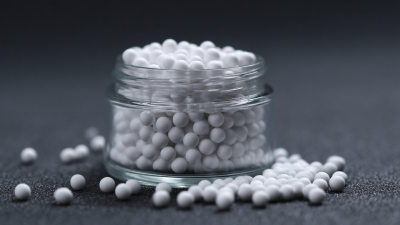
What is Cerium Stabilized Zirconia Ball and its Applications?
Cerium Stabilized Zirconia Ball is gaining attention in various industries. Recent industry reports show a growing demand for this material, especially in aerospace and medical applications. Companies are prioritizing innovations that leverage the unique properties of Cerium Stabilized Zirconia Balls, such as high strength and thermal stability.
Dr. Michael Johnson, a renowned expert in materials science, highlighted, "Cerium Stabilized Zirconia Balls are revolutionizing high-performance applications." This innovative material is crucial for enhancing durability in extreme conditions. Its remarkable resistance to wear and degradation makes it suitable for demanding environments.
Despite its advantages, some challenges remain. The manufacturing process can be complex, and ensuring consistency is vital. Understanding the full potential of Cerium Stabilized Zirconia Balls will require ongoing research and development. This field presents both opportunities and challenges for manufacturers. As the industry evolves, clarity on best practices will be essential to maximize the benefits of this remarkable material.

What is Cerium Stabilized Zirconia?
Cerium stabilized zirconia (CSZ) is a high-performance ceramic material. It combines zirconia with cerium oxide to enhance its properties. This mixture significantly improves stability and toughness, making CSZ ideal for various high-temperature applications. According to markets and research reports, the demand for CSZ is projected to grow by 6% annually through 2027, reflecting its increasing use in diverse fields.
CSZ exhibits excellent thermal stability and resistance to wear, enhancing its value in industries like aerospace and automotive. In fuel cells, CSZ acts as a solid electrolyte. It helps improve efficiency by maintaining ionic conductivity at high temperatures. These properties allow for smaller and lighter battery designs. Additionally, CSZ serves in dental applications for its biocompatibility and aesthetic appeal.
Tip: Always consider the environmental conditions when using CSZ. Its performance may vary in extreme settings. Therefore, testing in relevant conditions is crucial for optimizing applications.
While CSZ advances technology, some challenges remain. For instance, its production can be complex and costly. Researchers continue to explore ways to reduce manufacturing expenses while maintaining quality. A robust understanding of CSZ's properties could lead to innovations that further expand its applications.
Structure and Properties of Cerium Stabilized Zirconia
Cerium stabilized zirconia (CSZ) is a unique material, widely appreciated for its impressive properties. The structure of CSZ consists of a crystalline framework, primarily made of zirconium dioxide (ZrO2), with cerium oxide (CeO2) introduced as a stabilizer. This incorporation helps maintain stability at high temperatures, making CSZ an excellent choice for various applications. The addition of cerium enhances the ionic conductivity of zirconia, which is crucial in fuel cells and sensors.
The properties of cerium stabilized zirconia are noteworthy. It exhibits high resistance to thermal shock and mechanical wear. This durability makes it suitable for harsh environments. CSZ also has a relatively low thermal expansion coefficient, which leads to better compatibility with other materials. However, some challenges exist, such as its sensitivity to rapid temperature changes. This instability can lead to cracking. Researchers continue to explore ways to improve CSZ's resilience without compromising its beneficial properties. Balancing these aspects is essential in developing more reliable applications.
What is Cerium Stabilized Zirconia Ball and its Applications? - Structure and Properties of Cerium Stabilized Zirconia
| Property |
Value |
| Chemical Composition |
ZrO2 + CeO2 |
| Stabilizer Concentration |
Up to 20% CeO2 |
| Density |
6.0 - 6.2 g/cm³ |
| Thermal Conductivity |
2.5 W/m·K |
| Melting Point |
Higher than 2700 °C |
| Fracture Toughness |
5-8 MPa·m1/2 |
| Applications |
Biomedical implants, fuel cells, catalytic converters, and cutting tools. |
Production Methods for Cerium Stabilized Zirconia Balls
Cerium stabilized zirconia balls, known for their exceptional durability, are produced through various methods. The most common approach is solid-state reaction. In this process, zirconium dioxide is mixed with cerium oxide at high temperatures. This results in a uniform ceramic material. The reaction often requires precise temperature control. Inadequate heating can lead to impurities and affect the final product's quality.
Another method is the sol-gel process. Here, precursor materials are dissolved in a solvent. This solution undergoes hydrolysis and polymerization. The formation of a gel leads to a finer distribution of particles. This technique provides excellent control over the composition and morphology. However, the process can be sensitive to environmental factors like humidity and temperature.
There are also advanced techniques, like co-precipitation. This method involves preparing a mixed solution of both cerium and zirconium ions. The solution is then treated to induce precipitation. The resulting powder is calcined to form the final ceramic balls. Each production method has its advantages and challenges. Quality control remains crucial throughout to ensure reliability in various applications.
Applications of Cerium Stabilized Zirconia Balls in Various Industries
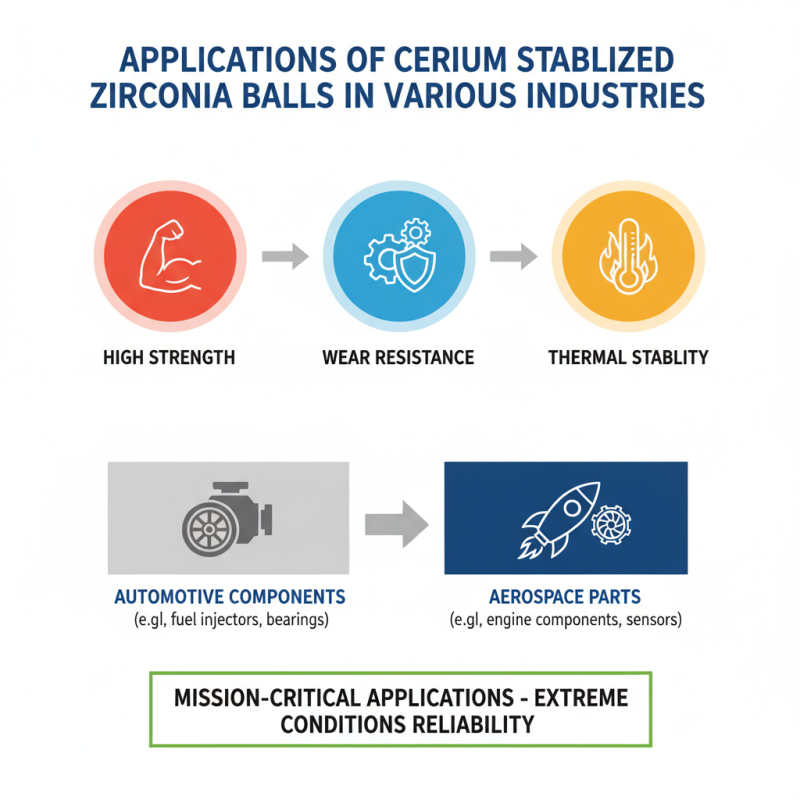
Cerium stabilized zirconia balls are highly valued in various industries due to their unique properties. These balls are known for their high strength, wear resistance, and excellent thermal stability. Consequently, they find extensive applications in fields like automotive and aerospace. In these sectors, they are used in components that must withstand extreme conditions. This reliability makes them indispensable for mission-critical applications.
In the medical field, cerium stabilized zirconia balls are used in dental implants and prosthetics. Their biocompatibility offers a significant advantage. Patients benefit from enhanced durability and comfort. Furthermore, their chemical resistance ensures longevity. However, the use of these materials raises questions about ethical sourcing and environmental impact. Industry professionals must consider these aspects while striving for progress.
Cerium stabilized zirconia balls also play a role in electronics. Their insulating properties help improve device efficiency. Yet, as demand grows, so do concerns about sustainability and resource management. Balancing innovation with ecological responsibility is crucial. As industries evolve, the spotlight will be on how to minimize the environmental footprint while maximizing performance.
Advantages of Using Cerium Stabilized Zirconia Balls in Technology
Cerium Stabilized Zirconia (CSZ) balls are gaining traction in various industries due to their unique properties. These balls exhibit exceptional mechanical strength, wear resistance, and thermal stability. According to a recent report by Grand View Research, the global zirconia market is projected to reach $2.94 billion by 2027, reflecting the growing demand for advanced materials in technology.
One notable advantage of CSZ balls is their high toughness. This property makes them ideal for applications in cutting tools and bearings. Studies indicate that CSZ can withstand harsh environmental conditions, making them preferred choices in aerospace and automotive sectors. The low thermal conductivity of CSZ balls also enhances energy efficiency, critical in modern manufacturing processes.
However, the production of Cerium Stabilized Zirconia can be complex and costly. Some manufacturers face challenges in achieving uniform particle sizes. This inconsistency can lead to variability in performance, raising quality concerns. As industries push for precision, these factors demand continual improvements in production methodologies. Addressing these issues will be vital for unlocking the full potential of CSZ balls across various applications.
Applications of Cerium Stabilized Zirconia Balls